
August 3: Songs of the Aztec Nobility
This week, we head northward to Mexico and Guatemala, where indigenous cultures continue to have a major presence. Some nine million people speak one of the many indigenous languages, chiefly Nahuatl or one of twenty-one Mayan languages, often with many Spanish words mixed in. Religiously and culturally as well, Mexico and Guatemala are home to complex interweavings. Thirty years ago, I bought a striking mask in an outdoor market on the edge of Mexico City. It portrays a woman who could be a Hollywood starlet, but for her horns, adorned with ribbons in the colors of the four sacred directions.

When I asked the seller who she represented, he replied: “Esa es La Malinche” – Hernán Cortés’ interpreter and adviser; their son, Martin, was one of the first mestizos born in the hemisphere. In native representations, her skin is often given a pink hue to signify the passion that led her to betray her people; in this case, the artist has gone so far as to make her a blue-eyed gringa.
Having subdued the Aztec empire over the course of 1519-1521, in 1525 Cortés sent an embassy to Pope Clement VII in Rome. With Clement’s support, he could advance the spiritual conquest of colonial “Nueva España” and solidify his political position back in Madrid. To pique the Pope’s interest, Cortés sent gifts of ornate native feather work, together with several Aztec nobles, regal representatives of twenty million souls ripe for conversion to the True Faith. Unfortunately for Cortés, His Holiness – bastard son of Guiliano de’ Medici – wasn’t impressed by feathers. Clement was consumed with power struggles at home in Italy, and he had little time for exotic visitors from the other side of the world. One of these unwelcome guests, though, was a poet who composed a sardonic record of the encounter in Nahuatl:
Friends, willow men, behold the pope,
who’s representing God, who speaks for him.
The pope is on God’s mat and seat and speaks for him.
Who is this reclining on a golden chair? Look! It’s the pope.
He has his turquoise blowgun and he’s shooting in the world.
It seems it’s true, he has his cross and golden staff, and these are shining in the world.
I grieve in Rome and see him in the flesh, and he’s San Pedro, San Pablo!
It seems that from the four directions they’ve been captured:
you’ve made them enter the golden refuge, and it’s shining.
It seems the pope’s home lies painted in golden butterflies. It’s beaming.
The pope probably wasn’t sitting on a mat and shooting darts from a turquoise blowgun, but this was a way to convey his power to the audience back home. The poet goes on to sum up the true interests of the heir of Saint Peter and Saint Paul: “He’s said: What do I need? Gold! Everybody bow down! Call out to Tiox in excelsis!” Here three languages rub shoulders in four words: wedged in between the Nahuatl tlamataque (“call out to”) and the Latin in excelsis, the seemingly foreign figure of Tiox is none other than the Spaniard’s God, the poet’s approximation of “Dios.” World literature is often the product of worlds in collision.
Some hundred and fifty Nahuatl poems survive from the sixteenth century, and they give us unique access to the thought world of the Aztecs and their (often reluctant) allies, helping us to understand a culture that seemed utterly foreign to the Spanish invaders. Late in life, Cortés’s soldier Bernal Díaz del Castillo recalled that
when we saw so many cities and villages built in the water and other great towns on dry land . . . . some of our soldiers even asked whether the things that we saw were not a dream. It is not to be wondered at that I here write it down in this manner, for there is so much to think over that I do not know how to describe it, seeing things as we did that had never been heard of or seen before, nor even dreamed about.
As Calderón de la Barca would later put it in his best-known play, La vida es sueño – “Life is a dream.” The polytheistic, cannibalistic Aztecs were radically different in many respects from their astonished visitors, but their poets too often spoke of life as a dream:
So it has been said by Tochihuitzin,
so it has been said by Coyolchiuqui:
We come here only to sleep, we come here only to dream;
it is not true, it is not true that we come to live on earth.
A delicate aestheticism pervades many of their poems, imbued with a sense of the transience of life:
Friends, take pleasure!
Let us put our arms around each other’s shoulders.
We’re living in a world of flowers here.
No one when he’s gone can enjoy the flowers, the songs,
that lie outspread in this home of the Giver of Life.
The Aztecs had something else in common with their European counterparts, though: they were enthusiastic imperialists, expanding their empire by conquest, shifting alliances, and brutal suppressions of revolt. These activities too were celebrated by their poets, who seem to have vied with each other to create ever more striking images to link beauty and terror: “Jaguar flowers are opening, / knife-death flowers are becoming delicious upon the field.” Warfare even becomes a grotesque kind of girls’ picnic: “Get up, sisters, and let’s go! Let’s go look for flowers. . . . Here they are! Here! Blaze flowers, shield flowers! Desirable, pleasurable war flowers!”
The Aztecs’ delicate, violent world turned upside down with the Spanish conquest. Language and writing were as important instruments of conquest as rifles and armor, as can be seen in a sixteenth-century painting of Hernán Cortés accepting the Aztec rulers’ surrender.

The Tlaxcalan painting shows a lordly Cortés, somewhat implausibly adorned with a feathered crown, with La Malinche behind him as translator, accepting the defeat of the Tlaxcalans’ bitter enemies, the Mexica (commonly known today as the Aztecs). The caption reads “Yc poliuhque mexiica” (“Here the Mexica surrendered”). The native artist has almost gotten the new Roman alphabet right, though he’s written the first “u” of “poliuhque” upside down, looking like an “n.”
It only gradually became clear to the Spaniards’ native allies just how much they had lost with their victory over Moctezuma. Amid the hardships of forced labor and the drastic effects of smallpox, by the century’s end Mexico’s native population had been reduced by some ninety percent. The poets who survived the Conquest could no longer celebrate their leaders’ victories or the aesthetic pleasures bought with imperial wealth. Instead, poetry became a means of resistance. One poem affirms the power of song to strengthen the Aztec leaders even when the Spanish tortured them in hopes of finding hidden stashes of gold: “Yet peacefully were Motelchiuh and Tlacotzin taken away. They fortified themselves with song in Acachinanco when they went to be delivered to the fire in Coyohuacan.”
Though the Spaniards burned almost all the native books they could find, oral traditions were harder to extirpate. And for all the destruction caused by the conquest, the Spaniards brought with them a powerful technology – the Roman alphabet – that would prove to be critical for the survival of the early court poetry that we can still read today. Seeking better to understand the natives he was trying to convert, a 16th-century priest named Bernardino de Sahagún compiled a multivolume bilingual ethnographic encyclopedia, the Historia general de las cosas de la Nueva España.
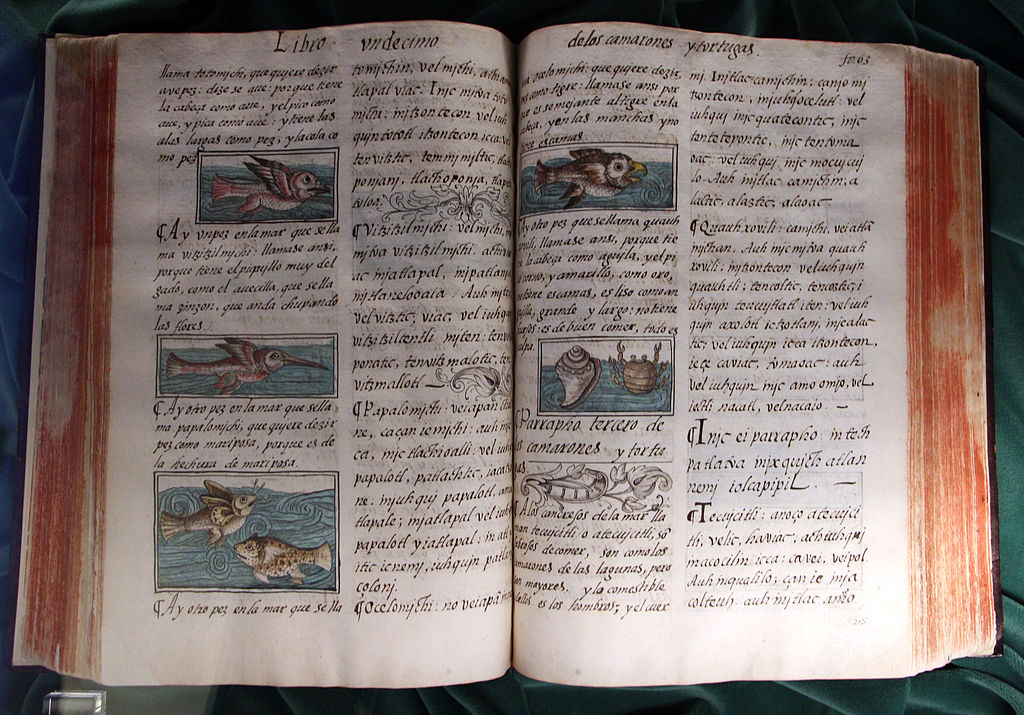
Disturbed by the persistence of native songs and dances, he also composed an entire volume of psalms in Nahuatl. In a preface, he noted that the natives were faithfully attending Mass, “but in other places – in most places – they persist in going back to singing their old canticles in their houses or their palaces (a circumstance that arouses a good deal of suspicion as to the sincerity of their Christian faith).” He attempted to win the natives over with psalms written in familiar terms: Jesus is implanted as “a quetzal plume in Mary’s womb,” and local songbirds such as troupials and trogons celebrate his birth. The volume was soon banned by Church authorities who didn’t want to give even that much ground to local traditions, and it was forgotten for centuries.
The only lasting result of Sahagún’s counter-poetic endeavor was the collection of a rich trove of native poems, which he apparently compiled as a database for his own compositions. These are preserved in two manuscripts known today as the Romances de los señores de la Nueva España (Ballads of the Lords of New Spain) and the Cantares Mexicanos. There is an excellent bilingual edition of the Cantares by John Bierhorst, and a selection can be found in Miguel León-Portilla and Earl Shorris’s anthology, In the Language of Kings. In these poems, we can see the Aztecs’ world from within, and we can envision Moctezuma not as an enigmatic and defeated figure, but as a poet in his own right, preserving his lost world in his immortal songs:
Moctezuma, you creature of heaven,
you sing in Mexico, in Tenochtitlan.
Here where eagle multitudes were ruined,
your bracelet house stands shining—
there in the house of Dios our father. . . .
and in that place these nobles gain renown and honor,
bells are scattered, dust and lords grow golden.
With their intense awareness of the brevity of life, and their faith in the transcendent power of poetry, the Aztec court poets would surely appreciate the poetic irony that their songs survive today precisely as a result of Sahagún’s attempt to stamp them out.